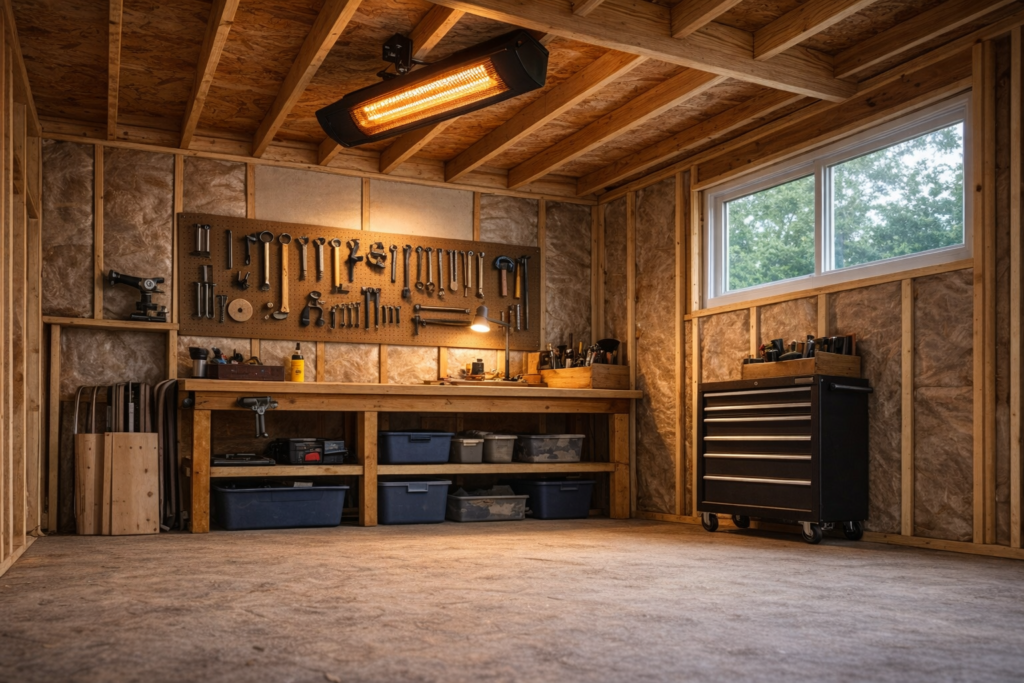
A ceiling-mounted electric heater is a practical option when wall and floor space are limited. It keeps equipment clear, distributes heat from above, and works well in workshop-style sheds.
This guide explains when a ceiling heater makes sense and how to choose the right size and voltage.
Why Choose a Ceiling Mounted Heater?
Ceiling-mounted heaters are ideal if:
-
Wall space is occupied by shelving or tools
-
Floor space needs to stay clear
-
You want heat distributed evenly across the room
-
The shed is used as a workshop
By mounting overhead, heat can circulate more freely without obstruction.
For general sizing guidance, see What Size Electric Heater Do I Need for a Shed?
When a Ceiling Heater Works Best
Ceiling heaters are most effective in:
-
Medium sheds (150–250 sq ft)
-
Workshop sheds with workbenches along the walls
-
Sheds with limited mounting options
-
Spaces where consistent airflow is important
If your shed is under 100 sq ft, a smaller wall or portable unit may be more practical. See Best Electric Heater for a Small Shed (Under 100 sq ft).
Wattage Requirements
Sizing follows the same basic formula:
Insulated shed
10 watts per square foot
Uninsulated shed
12–15 watts per square foot
For example:
200 sq ft insulated shed
200 × 10 = 2,000 watts
200 sq ft uninsulated shed
200 × 12–15 = 2,400–3,000 watts
For a full breakdown, see How Many Watts to Heat a Shed?
120V vs 240V Ceiling Heaters
Most ceiling-mounted heaters are 240V because they provide higher output.
120V ceiling heaters
-
Limited to around 1,500 watts
-
Suitable for small sheds
240V ceiling heaters
-
2,000–5,000+ watts
-
Better for medium to large sheds
-
Faster warm-up times
If you’re unsure about wiring requirements, review Do You Need a Dedicated Circuit for a Shed Heater?
For voltage comparisons, see:
Installation Considerations
Before installing a ceiling heater, check:
-
Ceiling height
-
Mounting bracket support
-
Clearance from stored materials
-
Direction of airflow
-
Electrical capacity
Standard 8-foot ceilings work well. Very high ceilings may require higher wattage to compensate for rising warm air.
Professional installation is often recommended for 240V models.
Safety in Shed Environments
Ceiling-mounted heaters should include:
-
Overheat protection
-
Enclosed heating elements
-
Adjustable mounting angle
-
Built-in thermostat or compatible external control
Keep proper clearance from stored wood, fuel, or insulation.
For more safety guidance, see Is It Safe to Run an Electric Heater in a Shed?
Ceiling Heater vs Wall Heater
Ceiling heaters distribute air downward and outward. Wall heaters direct airflow horizontally.
Wall heaters are often easier to install. See Best Wall Mounted Electric Heater for a Shed for comparison.
Final Thoughts
A ceiling-mounted electric heater is a strong choice for:
-
Medium to large sheds
-
Workshop-style layouts
-
Spaces where walls are fully used
-
Permanent heating setups
Choose the correct wattage, confirm electrical capacity, and ensure safe installation for reliable long-term performance.
For a full overview of all heater options, return to Best Electric Heater for a Shed (Complete Buyer Guide).