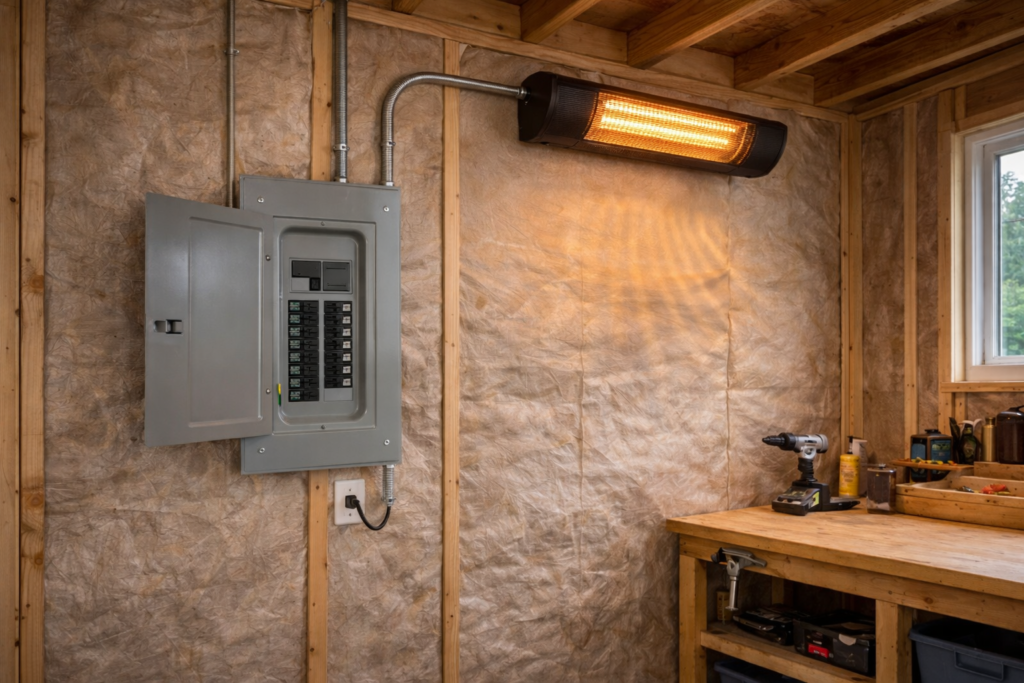
Adding an electric heater to a shed often raises an important question: do you need a dedicated circuit?
The answer depends on the heater’s voltage, wattage, and what else is running on the same electrical line.
This guide explains when a dedicated circuit is necessary and when it may not be.
What Is a Dedicated Circuit?
A dedicated circuit supplies power to a single appliance or device. It is not shared with lights, outlets, or other equipment.
This reduces:
-
Breaker trips
-
Overloaded wiring
-
Voltage drops
-
Fire risk
Higher-wattage heaters are more likely to require their own circuit.
120V Heaters and Circuit Needs
Most 120V shed heaters:
-
Max out at 1,500 watts
-
Draw around 12–13 amps
If the shed outlet is on a 15-amp circuit and nothing else is running on it, the heater may operate safely without a separate circuit.
However, problems occur if:
-
Power tools share the same line
-
Lighting is on the same breaker
-
Extension cords are used
If you’re considering a 120V model, see Best 120V Electric Heater for a Shed.
240V Heaters Almost Always Need a Dedicated Circuit
Most 240V heaters:
-
Produce 2,000–5,000+ watts
-
Draw significantly more current
-
Require specific breaker sizing
These heaters are typically hardwired and require a dedicated 240V circuit.
If you’re evaluating higher-output models, see Best 240V Electric Heater for a Shed.
How Wattage Affects Circuit Requirements
The larger the heater, the more current it draws.
For example:
1,500 watt heater (120V)
Around 12.5 amps
3,000 watt heater (240V)
Around 12.5 amps (at 240V)
Even though the amperage may appear similar, circuit requirements differ based on voltage and breaker configuration.
If you haven’t calculated your heating needs yet, review How Many Watts to Heat a Shed?
Signs You May Need a Dedicated Circuit
You likely need a dedicated circuit if:
-
The breaker trips when the heater runs
-
Lights dim when the heater turns on
-
The shed uses power tools regularly
-
You are installing a 240V heater
-
The heater exceeds 1,500 watts
Electrical safety should always take priority over convenience.
Installation Considerations
Before installing a heater:
-
Confirm breaker rating
-
Check wire gauge
-
Avoid extension cords
-
Ensure proper grounding
Professional installation is recommended for any new 240V circuit.
For general safety guidance, see Is It Safe to Run an Electric Heater in a Shed?
Final Thoughts
You may not need a dedicated circuit for a small 120V heater in a lightly used shed.
You almost always need one for:
-
240V heaters
-
Larger sheds
-
High-wattage units
-
Workshop environments
When in doubt, consult a licensed electrician to ensure safe installation.
For a broader overview of heater options and sizing, return to Best Electric Heater for a Shed (Complete Buyer Guide).