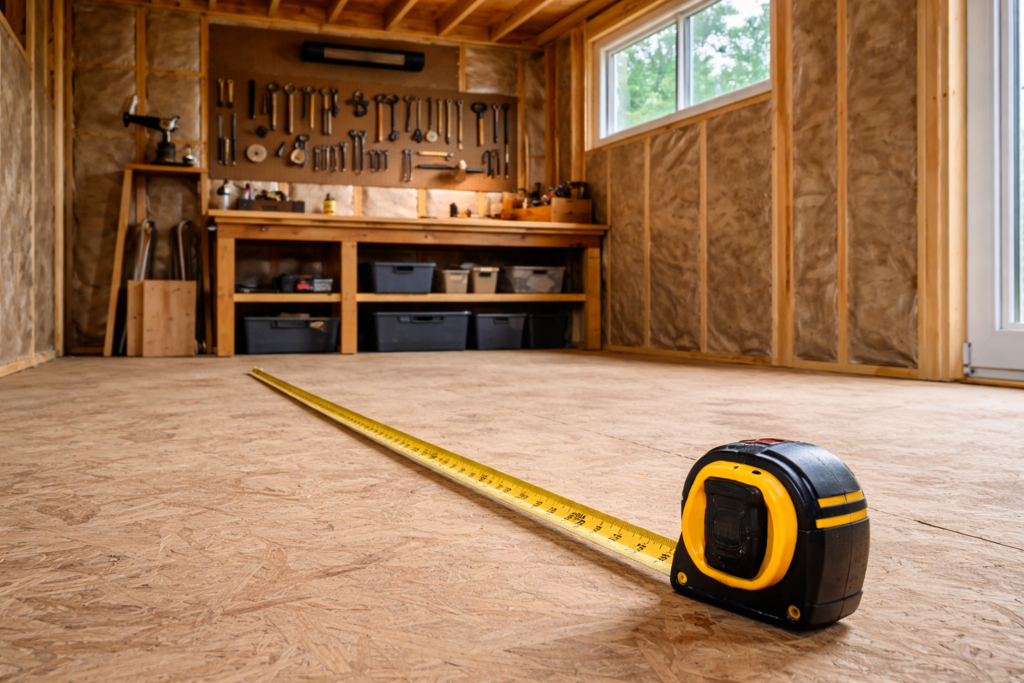
Choosing the right heater size is the most important step in heating a shed properly. If the heater is too small, the space will never feel warm. If it’s too large, you may overspend on equipment and electricity.
This guide explains how to calculate the correct electric heater size for your shed based on square footage, insulation, and usage.
Step 1: Measure Your Shed
Start by calculating the square footage.
Multiply:
Length × Width = Square Feet
Examples:
-
8 × 8 shed = 64 sq ft
-
10 × 10 shed = 100 sq ft
-
10 × 12 shed = 120 sq ft
-
12 × 16 shed = 192 sq ft
If your shed has a high ceiling (over 9 feet), you may need slightly more heating capacity.
For a detailed breakdown by shed size, see Electric Heater Size Chart for Sheds by Square Footage.
Step 2: Use the Basic Wattage Formula
Electric heaters are rated in watts. A common sizing rule is:
Insulated shed:
10 watts per square foot
Uninsulated shed:
12–15 watts per square foot
Example Calculations
100 sq ft insulated shed
100 × 10 watts = 1,000 watts
100 sq ft uninsulated shed
100 × 12–15 watts = 1,200–1,500 watts
192 sq ft insulated shed
192 × 10 watts = 1,920 watts
If you are unsure about insulation performance, review Best Electric Heater for an Uninsulated Shed.
Step 3: Match Wattage to Heater Type
Once you know your wattage requirement, match it to a heater category.
Up to 1,500 watts
Suitable for small sheds under 150 sq ft
Often available in 120V portable or wall-mounted models
1,500–3,000 watts
Suitable for medium sheds (150–250 sq ft)
Usually requires 240V power
3,000+ watts
Larger workshops over 250 sq ft
Typically 240V ceiling or wall-mounted heaters
If you’re comparing voltage options, see:
Step 4: Consider Climate
Colder climates may require slightly higher wattage. If your shed is in a region with freezing winters, add a small safety margin to your calculation.
Mild winter areas may allow you to stay at the lower end of the wattage range.
Step 5: Account for Heat Loss Factors
You may need additional wattage if your shed has:
-
Thin or no wall insulation
-
Uninsulated roof
-
Drafty doors
-
Single-pane windows
-
Concrete slab floors without insulation
Improving insulation often reduces heater size requirements and lowers running costs.
For cost considerations, see How Much Does It Cost to Run an Electric Shed Heater?
Quick Heater Size Guide
Under 100 sq ft
1,000–1,500 watts
100–150 sq ft
1,500–2,000 watts
150–200 sq ft
2,000–2,500 watts
200–300 sq ft
2,500–3,500 watts
For scenario-specific recommendations, see:
When to Choose a Larger Heater
Choose the higher end of the wattage range if:
-
The shed is uninsulated
-
You use the shed daily in winter
-
You want faster warm-up times
-
The shed ceiling is high
Choose the lower end if:
-
The shed is well insulated
-
Winters are mild
-
You only need occasional heating
Final Thoughts
To determine what size electric heater you need for a shed:
-
Measure square footage
-
Multiply by 10 watts (insulated) or 12–15 watts (uninsulated)
-
Adjust for climate and heat loss
Proper sizing ensures efficient operation, comfortable temperatures, and manageable energy costs.
If you’re still deciding, the main guide Best Electric Heater for a Shed (Complete Buyer Guide) walks through heater types and installation options.