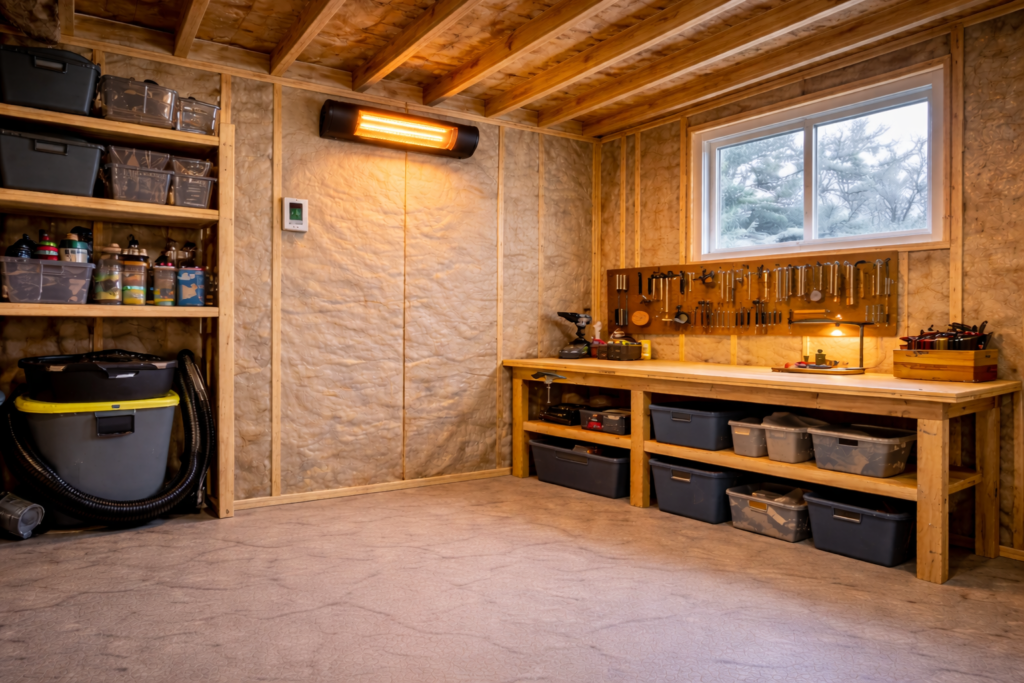
Electric heaters are nearly 100% efficient at converting electricity into heat. However, some models and setups operate more efficiently in real-world shed environments.
This guide explains what “energy efficient” really means for shed heating and how to reduce electricity use.
What Efficiency Means for Electric Heaters
All resistance electric heaters convert almost all input electricity into heat. There is very little difference in core heating efficiency between models.
Energy efficiency in a shed depends more on:
-
Correct sizing
-
Insulation quality
-
Thermostat control
-
Runtime management
If you have not sized your heater yet, see What Size Electric Heater Do I Need for a Shed?
Proper Sizing Improves Efficiency
An undersized heater:
-
Runs continuously
-
Struggles to reach target temperature
-
Uses more total electricity over time
An oversized heater:
-
Heats quickly
-
Cycles off sooner
-
May reduce runtime
For correct wattage calculations, see How Many Watts to Heat a Shed?
Thermostat Control Is Key
The most efficient shed heaters include:
-
Built-in adjustable thermostats
-
External thermostat compatibility
-
Automatic cycling
A thermostat prevents the heater from running longer than necessary.
Heaters without thermostats are less efficient because they require manual control.
Insulation Has the Largest Impact
Improving insulation is often more effective than upgrading the heater.
Insulation helps by:
-
Reducing heat loss
-
Lowering runtime
-
Maintaining stable temperatures
If your shed lacks insulation, review Best Electric Heater for an Uninsulated Shed.
120V vs 240V and Efficiency
Voltage does not determine efficiency directly.
A 3,000 watt heater costs the same to operate whether it runs on 120V or 240V. However, 240V heaters:
-
Deliver higher output
-
Heat faster
-
Maintain temperature better in larger sheds
For medium or large sheds, stepping up to 240V often improves overall performance.
See Best 240V Electric Heater for a Shed for higher-output options.
Heater Type and Airflow
Fan-forced heaters typically distribute heat more evenly than radiant-style units in sheds.
Even heat distribution:
-
Reduces cold spots
-
Allows thermostat cycling
-
Improves comfort without increasing wattage
Wall or ceiling-mounted fan heaters often perform better in workshop environments.
Simple Ways to Reduce Energy Use
You can lower operating costs by:
-
Sealing door gaps
-
Adding weather stripping
-
Insulating the roof
-
Using a programmable timer
-
Heating only when needed
Even small upgrades can reduce total runtime.
For cost estimates, see How Much Does It Cost to Run an Electric Shed Heater?
Final Thoughts
The most energy efficient electric heater for a shed is not defined by brand or technology.
Efficiency comes from:
-
Correct wattage
-
Good insulation
-
Thermostat control
-
Proper placement
When matched correctly to the space, an electric heater can provide steady warmth without excessive operating costs.
For a full overview of shed heater types and setup options, return to Best Electric Heater for a Shed (Complete Buyer Guide).