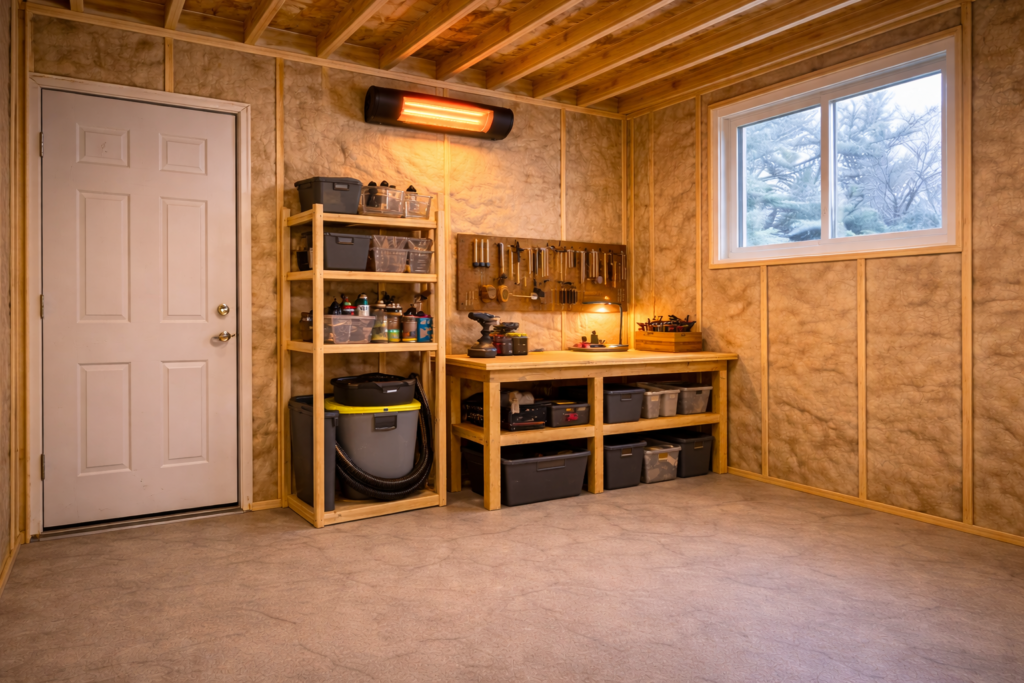
An insulated shed is much easier to heat than an uninsulated one. Because insulation slows heat loss, you can often use a smaller heater and achieve more stable temperatures.
This guide explains how to choose the best electric heater for an insulated shed and how insulation affects wattage, voltage, and operating cost.
How Insulation Changes Heating Requirements
In an insulated shed, use this general rule:
10 watts per square foot
For example:
100 sq ft insulated shed
100 × 10 = 1,000 watts
150 sq ft insulated shed
150 × 10 = 1,500 watts
This usually means you can stay within the range of smaller 120V heaters for compact sheds.
For a full breakdown of wattage calculations, see How Many Watts to Heat a Shed?
120V vs 240V in an Insulated Shed
Because insulation reduces heat loss, 120V heaters are often sufficient in sheds up to 150 sq ft.
A 120V heater is ideal if:
-
The shed is under 150 sq ft
-
Winters are moderate
-
You want a simple plug-in solution
See Best 120V Electric Heater for a Shed for suitable options.
For larger insulated sheds over 150–200 sq ft, stepping up to 240V provides faster warm-up and more consistent cycling.
See Best 240V Electric Heater for a Shed if you need higher output.
Best Heater Types for Insulated Sheds
Insulated sheds allow more flexibility in heater choice.
Wall Mounted Heaters
Wall-mounted units work well because:
-
They provide steady airflow
-
They free up floor space
-
They distribute heat evenly
See Best Wall Mounted Electric Heater for a Shed for installation guidance.
Portable Heaters
Portable heaters can perform well in insulated sheds, especially smaller ones.
They are:
-
Easy to install
-
Cost-effective
-
Suitable for occasional use
Energy Efficiency Benefits
Insulation improves efficiency by:
-
Reducing runtime
-
Allowing the heater to cycle off
-
Maintaining stable temperatures
-
Lowering electricity costs
If you want to estimate operating expenses, see How Much Does It Cost to Run an Electric Shed Heater?
Do You Need High Wattage?
In most insulated sheds:
-
Oversizing is unnecessary
-
Moderate wattage heats effectively
-
Thermostat control improves efficiency
However, very cold climates may still require the higher end of the wattage range.
If you are unsure about overall heater selection, return to Best Electric Heater for a Shed (Complete Buyer Guide).
Final Thoughts
The best electric heater for an insulated shed is usually:
-
Correctly sized using 10 watts per square foot
-
120V for small sheds
-
240V for larger insulated spaces
-
Wall-mounted or portable depending on layout
Insulation allows the heater to operate more efficiently, cycle properly, and maintain comfort with lower overall energy use.