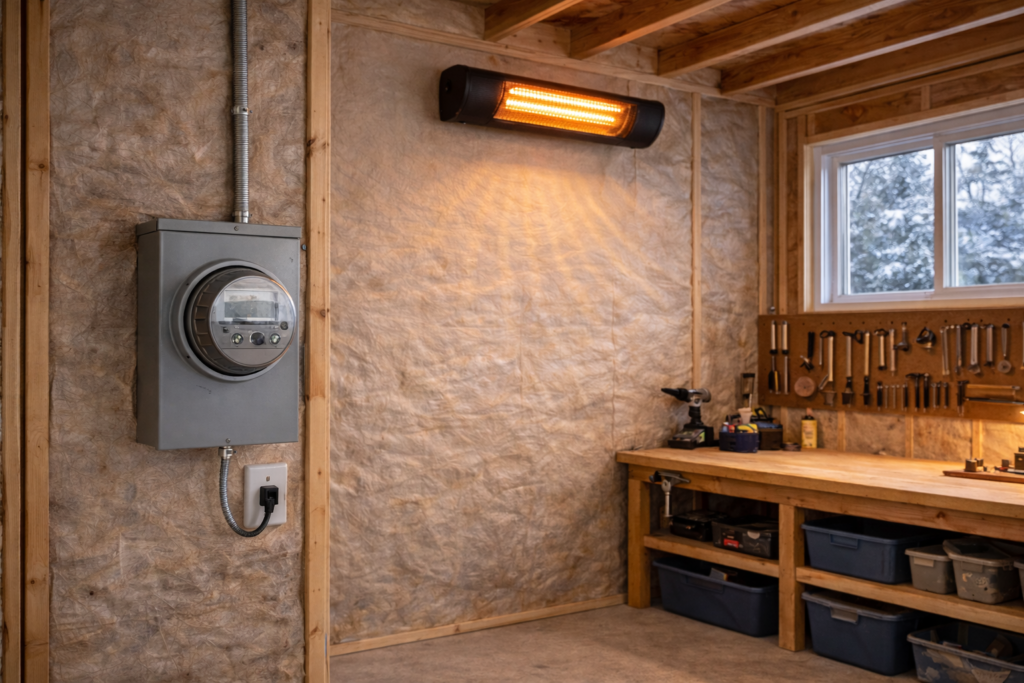
The cost to run an electric heater in a shed depends on three main factors: wattage, runtime, and your local electricity rate.
This guide explains how to estimate operating costs and how insulation and heater size affect long-term expenses.
Step 1: Understand Heater Wattage
Electric heaters are rated in watts. Common shed heater sizes include:
-
1,000 watts
-
1,500 watts
-
2,000–3,000 watts
-
4,000+ watts
The higher the wattage, the more electricity the heater uses per hour.
If you have not calculated your required wattage, see How Many Watts to Heat a Shed?
Step 2: Convert Watts to Kilowatt-Hours
Electricity is billed in kilowatt-hours (kWh).
To calculate usage:
Watts ÷ 1,000 = Kilowatts
Then multiply by hours used.
Example:
1,500 watt heater
1,500 ÷ 1,000 = 1.5 kW
If it runs for 4 hours:
1.5 × 4 = 6 kWh
Step 3: Multiply by Electricity Rate
Electricity rates vary by location.
If your rate is $0.25 per kWh:
6 kWh × $0.25 = $1.50
That means a 1,500 watt heater running 4 hours costs about $1.50.
Larger heaters cost more per hour, but they may heat the space faster and cycle off sooner.
Sample Cost Estimates
Here are rough examples using a $0.25 per kWh rate.
1,500 watt heater
1.5 kWh per hour
Cost per hour: $0.38
3,000 watt heater
3 kWh per hour
Cost per hour: $0.75
If used 3–4 hours per day during winter, monthly cost depends heavily on insulation and climate.
Insulation Affects Cost More Than Wattage
An insulated shed:
-
Heats faster
-
Cycles off more often
-
Uses less total energy
An uninsulated shed:
-
Loses heat quickly
-
Causes heater to run longer
-
Increases operating cost
If your shed lacks insulation, see Best Electric Heater for an Uninsulated Shed.
120V vs 240V Operating Costs
A common question is whether 240V heaters cost more to run than 120V heaters.
Operating cost depends on wattage, not voltage.
A 3,000 watt heater costs the same per hour whether it runs on 120V or 240V.
The difference is that 240V heaters usually provide higher output and heat larger spaces more efficiently.
See Best 240V Electric Heater for a Shed for higher-capacity setups.
Ways to Reduce Heating Costs
You can lower operating costs by:
-
Improving insulation
-
Sealing door gaps
-
Using a programmable thermostat
-
Heating only when needed
-
Choosing the correct wattage (not oversized)
If you are still deciding on heater size, review What Size Electric Heater Do I Need for a Shed?
Final Thoughts
The cost to run an electric shed heater depends on:
-
Heater wattage
-
Daily runtime
-
Electricity rate
-
Insulation level
A properly sized heater in a well-insulated shed is often affordable to operate, especially for part-time use.
For a complete overview of heater types and setup options, return to Best Electric Heater for a Shed (Complete Buyer Guide).